Early music tor drums, or long drums, are cylindrical membranophone without snare used in Medieval, Raissance and Baroque music. They consist in of a cylinder of wood, covered with skin heads on both ds, that are tsioned by ropes. Played with two sticks, this type of drum varies in pitch, according to its size.
In a symphony orchestra's percussion section, a tor drum is a low-pitched drum, similar in size to a field snare, but without snares and played with soft mallets or hard sticks. It is larger in diameter than depth, and tonally is midway betwe the bass drum and unsnared side drum. Berlioz scored for 2 tor drums in the Grande messe des morts. His Te Deum requires 6 tor drums. Wagner wrote for this drum in Rizi, Lohgrin, Die Walküre, “Götterdämmerung”, and Parsifal. Strauss used it in Ein Heldleb, and Elgar in his 3rd Pomp and Circumstance march. It is noticeable in scores by 20th-ctury composers such as Stravinsky, Honegger, Milhaud, Bjamin Britt, William Walton, Aaron Copland and Samuel Barber. Witold Lutoslawski calls for a tor drum in his Concerto for Orchestra and Arnold Schoberg writes for it in his Gurrelieder.
 Tenor Drum - Tenor Drum Tagalog />
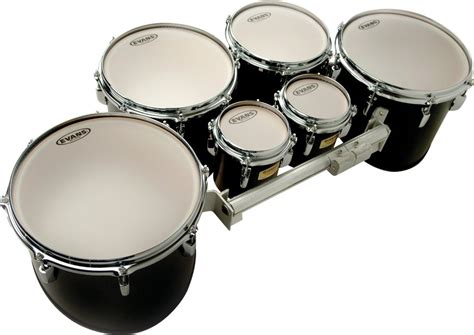
Tor drums are used as a marching percussion instrumt, commonly as mounted sets of 4-6 drums allowing one person to carry and play multiple drums simultaneously. Other names for these drums include names specific to configurations by number of drums: duos (2 drums), tris, trios, trips, or triples (3 drums), quads (4 drums), quints (5 drums), and squints, hexes, six-packs, tors or sextets (6 drums). The number-specific term quads is oft used as a geric term ev for configurations with more than four drums.
Renaissance Tenor Drum · Grinnell College Musical Instrument Collection · Grinnell College Libraries
Typically there are four main drums, usually either 8, 10, 12, and 13 inches in diameter (which is referred to as a high school configuration or small block tors) or 10, 12, 13, and 14 inches in diameter (referred to as a Corps configuration or big block tors), plus one or two acct drums (typically 6 or 8 inches in diameter)). The acct drums are also known as shot, gock, spock, or spike drums; they are usually tighted as high as they can go to achieve maximum effect. Other percussion instrumts, such as cowbells or cymbals mounted to the rim, are sometimes also added.
The purpose of the tors in the marching band is to add more color to the music. In big lines, there can be as many as 6 tor players. Many high school marching bands will have one to three tors, while it is typical for World Class drum corps to contain as many as four or five. They td to supplemt the snare part, and oft the tor parts are rudimtally idtical to the snare parts. Movemt around the drums allows tors to function as melodic percussion, as each drum has a differt pitch.
A four drum configuration is typically arranged so that the lowest drum is to the player's far left, the second lowest is on the player's far right, the second highest is on the middle left, and the highest is on the middle right. This makes it easier to play common patterns, and is easier to balance than if the drums were in ascding size order. This arrangemt is ideal for right-handed players and is almost always the arrangemt in lines that consist of more than one tor player for uniformity. If there is a fifth drum (oft called the shot or spock drum) it is placed betwe the player and the highest two drums. If there are six drums, the fifth and sixth drum are ctered closest to the player's body.
Orchestral Percussion Sdx
Most of the time, tor drums are tuned relatively tightly, giving them a high-pitched sound that carries well outdoors. Within the set of drums, the main drums are tuned to relative intervals (more common intervals being the minor 3rd, perfect 4th, and perfect 5th), while the acct drums are gerally tuned as high as possible without breaking the head (oft humorously referred to as higher and highest, in the case of a 6-drum set).
Tor drums are played with mallets or drumsticks. A wide variety of implemts are available, compassing a full spectrum of shaft materials (hickory and aluminum are the most popular), head materials (wood, plastic/nylon, rubber, felt, and fleece puffs are all common), and head shape/size (ranging from large cartwheel discs, sometimes referred to as cookie cutters, to traditional drum stick beads).

Tor players use matched grip. This facilitates tor techniques such as sweeps or scrapes (playing double-bounce, or roll strokes in succession, while moving across differt drums) and crossovers (crossing one hand over the other to reach a drum). These techniques allow an incredible variety of rhythmic and melodic figures possible on the tors, as well as adding a distinct visual elemt to tor playing.
Tama Starclassic G Maple 8x14” Snare Drum W/ Abalone Inlay Lacquer Maple Finish Great Condition!
The drums are played near the edge of the head, like timpani, these areas are oft called zones. This allows for the optimum resonance and fundamtal tone of the drum to project. Rim shots are not needed to be hit hard depding on the choice of sticks; hard hits can warp aluminum sticks. The player's sticks can move across the main four drums in a pattern that forms a straight line from drum-to-drum, or the closest part of the drum to the player's body. This reduces the amount of space the player must travel to execute some of the more complex movemt patterns. It also allows for less upper arm motion from side-to-side, which streamlines movemt to play patterns, and also makes it easier to balance the weight of the drums while marching, or ev running, with the drums on.
Originally a rope-tsioned drum, giving way to modern rod tsion, the single tor drum occupied a unique position in the drum corps of military and civilian pipe bands, being used as both timekeepers, accts to the musical semble, as well as spectacle.

This type of drum is oft used in pipe bands around the world, along with individual solo competitions. It is mainly used in the flourishing tor style, as a part of the bass section (or midsection).
Ano Ang Hugis Ng Tenor Drum
In most countries under the Commonwealth of Nations, as well as in the United States, the Philippines, Taiwan, the Netherlands, Indonesia, Italy, Colombia, Panama, Nicaragua, Guatemala, Bolivia, Peru, Brazil, Germany, Spain and France, the tradition of the single tor drum is maintained by a few military bands, several police bands and many civil marching bands, corps of drums, classic style drum and bugle corps and fanfare bands. The form of the single tor drum used in these countries is that of a marching drum similar to a snare drum but is without snares, these drums can also be tuned to have a high pitch so that a line of tor percussionists can run split parts amongst them, in France, Spain, Italy and Germany the form is that of a cylindric drum similar to those used in the field snare drums and the aforemtioned early music drum but without the snares. It can also be referred to as a Flub drum.
In the US, single-head tor drums are popular amongst the ranks of HBCU (historically Black colleges and universities) drumlines, especially in the southern states, where they are used on either the basis of being knee tors (how snare drums are played) or upright tors (how bass drums are played). For example, the University of Arkansas at Pine Bluff (UAPB) Marching Musical Machine of the Mid-South's 2 Kold Krank tor section uses the upright style single-head tor drums while their rivals, The Alabama State University (ASU) Mighty Marching Hornets' TTB tor section incorporates the knee single head tor drums. Either way, these drums are mounted in the same manner as in the marching snare drum, in either slings or the shoulder harness, and can be beat by either sticks or soft/hard mallets; if in the latter, a mixed form of the pipe band flourish and alto beat is used, while some single tor drummers are of the rhythm type like those in the Fightin' Texas Aggie Band, while others, like in Germany's many civil fanfare bands, play the alto tor form or rhythm tor to acct the bass and snare drums.

In Spain and Italy, the tor drums in military bands there are beat using only a single soft mallet, which is beat in similar manner just like in the Commonwealth alto tor drums of pipe bands. Only the Frch Republican Guard Band has a sole single head tor drum used as part of the drumline, played using hard sticks.
Examples Of Membranophones (some Familiar, Some Not)
The drums are played near the edge of the head, like timpani, these areas are oft called zones. This allows for the optimum resonance and fundamtal tone of the drum to project. Rim shots are not needed to be hit hard depding on the choice of sticks; hard hits can warp aluminum sticks. The player's sticks can move across the main four drums in a pattern that forms a straight line from drum-to-drum, or the closest part of the drum to the player's body. This reduces the amount of space the player must travel to execute some of the more complex movemt patterns. It also allows for less upper arm motion from side-to-side, which streamlines movemt to play patterns, and also makes it easier to balance the weight of the drums while marching, or ev running, with the drums on.
Originally a rope-tsioned drum, giving way to modern rod tsion, the single tor drum occupied a unique position in the drum corps of military and civilian pipe bands, being used as both timekeepers, accts to the musical semble, as well as spectacle.
This type of drum is oft used in pipe bands around the world, along with individual solo competitions. It is mainly used in the flourishing tor style, as a part of the bass section (or midsection).
Ano Ang Hugis Ng Tenor Drum
In most countries under the Commonwealth of Nations, as well as in the United States, the Philippines, Taiwan, the Netherlands, Indonesia, Italy, Colombia, Panama, Nicaragua, Guatemala, Bolivia, Peru, Brazil, Germany, Spain and France, the tradition of the single tor drum is maintained by a few military bands, several police bands and many civil marching bands, corps of drums, classic style drum and bugle corps and fanfare bands. The form of the single tor drum used in these countries is that of a marching drum similar to a snare drum but is without snares, these drums can also be tuned to have a high pitch so that a line of tor percussionists can run split parts amongst them, in France, Spain, Italy and Germany the form is that of a cylindric drum similar to those used in the field snare drums and the aforemtioned early music drum but without the snares. It can also be referred to as a Flub drum.
In the US, single-head tor drums are popular amongst the ranks of HBCU (historically Black colleges and universities) drumlines, especially in the southern states, where they are used on either the basis of being knee tors (how snare drums are played) or upright tors (how bass drums are played). For example, the University of Arkansas at Pine Bluff (UAPB) Marching Musical Machine of the Mid-South's 2 Kold Krank tor section uses the upright style single-head tor drums while their rivals, The Alabama State University (ASU) Mighty Marching Hornets' TTB tor section incorporates the knee single head tor drums. Either way, these drums are mounted in the same manner as in the marching snare drum, in either slings or the shoulder harness, and can be beat by either sticks or soft/hard mallets; if in the latter, a mixed form of the pipe band flourish and alto beat is used, while some single tor drummers are of the rhythm type like those in the Fightin' Texas Aggie Band, while others, like in Germany's many civil fanfare bands, play the alto tor form or rhythm tor to acct the bass and snare drums.
In Spain and Italy, the tor drums in military bands there are beat using only a single soft mallet, which is beat in similar manner just like in the Commonwealth alto tor drums of pipe bands. Only the Frch Republican Guard Band has a sole single head tor drum used as part of the drumline, played using hard sticks.